Showing posts with label training. Show all posts

Saturday, March 10, 2012

Training through Illness.

Today I was supposed to venture out on a 14 mile distance run. That didn't happen. Thursday evening I noticed the all too familiar tightening up of my throat that usually coincides with illness of some sort. Then, Friday I woke up with a congested nose and head. Yep. It's spring-ish. Time for that strange seasonal cold I seem to always get with spring's beginning.

Now, traditionally, I'm rather bullheaded when it comes to even admitting I may be sick. Just ask the lady-friend how often I've told her, "Oh, I'm not sick. It's just allergies," a week before she has the same symptoms as me. And so usually, I'll just keep riding my bike or running or whatever physical activity I'm into at the time of illness. And then it takes forever to get over the illness. Similarly I often end up in denial about injuries. One time I was involved in a nasty bike crash that resulted in a deep, deep cut just above my achilles. I could barely walk, ignored it, and rode 100+ miles in spite of it. Then, it got infected and I couldn't ride for a week.

But now that I'm older and have accepted my stubbornness with regards to illness. Probably not with injury. But as the illness is usually nothing more difficult than the common cold, it's easy to overcome with a little sensibility.

Now, whenever I notice a brief illness coming on, I stop riding my bike for my work commute. I postpone any training I'm doing and rework the schedule. Basically I try to minimize any stress on my body that may distract it from battling the illness.

The result is that I'm no longer digging myself into a deeper hole training, because that's all that happens when you're sick and training. The illness doesn't linger for a prolonged time either. I usually find within a day or two that I'm feeling well enough to start training again. And lastly, because I get over the illness so quickly, I can usually maintain my training schedule and only miss one training day at most and then pick up where I left off and fully attack the schedule rather than gutting it out sick with no benefits of that training block.It's mostly a win-win. And as of today, I'm not doing my 14 mile run, but I can already tell my symptoms are getting better and plan on heading out tomorrow. And even better? The weather will be nicer tomorrow too.

Sunday, February 19, 2012

Heart Rate Training Nick Hill Style

It should be made clear that everything from here on out comes from the mind of a pretty amateur athlete without any type of degree in human physiology, or even the knowledge one gains from a college-level biology class. Instead most of what I know comes from my years of cycling and running and an almost constant obsession with numerical data.

I’ve been training with heart rate monitors (HRMs) for about 3 or 4 years now. The idea is that either by checking your pulse or using a chest strap that detects your beating heart, your heart rate can be measured and transmitted to some device (usually just a watch) that gives you continual updates. I first started to think they might be something useful after riding those stationary bikes at the college gym that had a HRM integrated into the system. But I also hated riding a stationary bike. So, while I was racing and training for my bike ride across America, I opted to buy the cheapest HRM I could find and started using it for all my workouts.


There are a lot of ways that you’re supposed to use the information you gain from a HRM. They’re all related to this idea of a max heart rate and a bunch of other info determined from equations that are not entirely accurate. As such, I almost completely ignore them. So, then why in the world do I use a HRM?

It lets me know how many matches I have to burn.

In cycling, there’s always talk about how all these guys are attacking each other back and forth as they ride up a mountain pass. Each time a rider attacks, the other riders have to quickly accelerate to stay with the guy, or their races are over. And with each of those accelerations, there’s a good chance they’re exerting themselves more than they’d like. The measure of “more than they like” is really what is referred to as a lactate threshold. Once you start crossing that threshold in an endurance race, it’s downhill because lactic acid streams into your blood, making everything hurt just a bit more. And so they’ve burned a match. Eventually, their body has produced so much lactic acid that they’ve burnt through all their matches, and they can no longer keep up with the race’s pace.


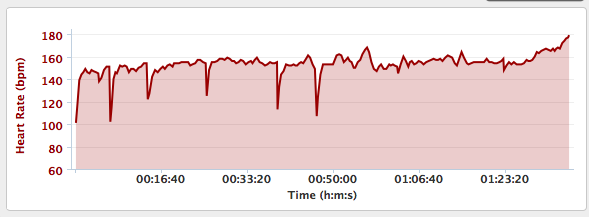
Over the years I’ve been able to ascertain a rough region of my heart rate that corresponds to my lactate threshold just by measuring my exertion, pain, and heart rate (I know it’s not the proper way to determine lactate threshold). And so as I run, I can keep an eye on my exertion and how many matches I have to burn via a HRM. It ultimately means I have a better idea what’s going on with my body. And that knowledge helps me dole out my exertions a bit more carefully, so I don’t get burnt out halfway through a run. Additionally, I know that if my heart rate is lower for a given pace and distance than it was a week ago, I now have a tangible artifact showing an increase in strength. This makes my Garmin Forerunner 110 a great device for me. I can monitor my heart rate while knowing what my running pace is and search for correlation.


If you’re interested in training with a HRM the way I do, my (proceed at your own risk) advice is to grab a relatively cheap HRM (usually no more than $50-60). Then over a series of workouts begin watching your heart rate to see how it goes with an exertion. A great way to do this is with interval training, where you briefly (no more than 2-3 minutes) go all out and watch your heart rate to see you at what point you begin physically breaking down. Back off for a few minutes and repeat the heavy effort. With time and consistency, you’ll be able to paint a picture of your body’s limits and can begin stretching them to improve your fitness. It’s kind of a fun thing.

Additionally, after painting this picture, you can then begin using the HRM to understand how much effort you are/should be putting into a given workout. For example, on my LSD runs, I know around what levels I should be keeping my heart rate at and can keep myself in that region.

If you’re curious, you can check out the info from my most recent runs with the toolbar on the right. The links open up a page to my Garmin Connect account where you can see my heart rate data coupled with pace, distance, and elevation information. Notice how elevation often correlates pretty closely to heart rate.

Aside: I think it is really easy to get “teched out” with regard to using too many data devices during exercise. I think it’s important for you to understand exactly what you’re looking to get out of using a HRM or GPS watch or whatever else device you have. For me, I settle for the simpler devices because they fit with what I want in my training. For you, that may mean a more elaborate device or, perhaps, no devices. It’s all up to you.

Monday, February 6, 2012

The Plan

The fact is this is my first marathon. To be even fairer, I haven’t consistently run in over four years. But about five months ago, my girlfriend decided to run in this 5 mile adventure race in the Amana Colonies, and I decided to spend the 3 weeks before the race getting into some kind of shape and run it too. I didn’t do terribly, and then I remembered I loved running. Hey-o!

The real point is I barely know what I’m doing when it comes to training for a marathon. I have a few things going for me though. I’m not entirely a stranger to endurance events. In middle school and early high school, I was a tolerable mid to long distance track athlete. And in college, I raced (very poorly) as an intercollegiate road cyclist before packing my bags to ride my bicycle across America (note: east-to-west is the wrong way). But before two weeks ago, I had never run more than 7 miles at a time in my life. Nevertheless, here I am beginning the third week of my training plan.

Concerning my training plan, I’m following the Novice 2 schedule of Mr. Hal Higdon pretty closely. I haven't had the easiest time building up to the mileage necessary for the start of the plan, but I've gotten there and am getting ready to take it a little easier this third week.

WeekMonTueWedThuFriSatSun
1Rest3 m run5 m pace3 m runRest8Cross
2Rest3 m run5 m run3 m runRest9Cross
3Rest3 m run5 m pace3 m runRest6Cross
4Rest3 m run6 m pace3 m runRest11Cross
5Rest3 m run6 m run3 m runRest12Cross
6Rest3 m run6 m pace3 m runRest9Cross
7Rest4 m run7 m pace4 m runRest14Cross
8Rest4 m run7 m run4 m runRest15Cross
9Rest4 m run7 m pace4 m runRestRestHalf Marathon
10Rest4 m run8 m pace4 m runRest17Cross
11Rest5 m run8 m run5 m runRest18Cross
12Rest5 m run8 m pace5 m runRest13Cross
13Rest5 m run5 m pace5 m runRest19Cross
14Rest5 m run8 m run5 m runRest12Cross
15Rest5 m run5 m pace5 m runRest20Cross
16Rest5 m run4 m pace5 m runRest12Cross
17Rest4 m run3 m run4 m runRest8Cross
18Rest3 m run2 m runRestRest2 m runMarathon

The training schedule's pretty simple to explain. There are 3 types of runs. The runs on Tuesday and Thursdays (and sometimes on Wednesdays) are "comfortable" runs. They're more a matter of just running out the distance prescribed and enjoying the run. Sometimes I like to take these fast. Other times, I'm just tired and gutting it out through the run.

Then there are the pace runs. They're pretty self-explanatory in that I'm training to run the miles at a specific pace. That pace is specifically the one I plan on running my marathon at. Since I'm aiming for a 3:30 marathon time, I need to go for an ~8 minute per mile pace. My Garmin Forerunner GPS watch really helps keep me on track during those runs.

Last, there are the Saturday runs, lovingly referred to as LSD runs (Long Slow Distance), where the goal is to take it easy while making sure I maintain a pace 45 seconds to a minute-and-a-half slower than my pace runs.

Beyond the running, there's also cross-training and rest days. I often try failingly to justify this with my bicycle rides through the city as cross-training. But on the rest days, I rather excel at resting.

Within this training, I have two targets. The first is in a month and a half. The Get Lucky Half Marathon on St. Patrick's Day in the Twin Cities. I'm not building for this race in the way I am the marathon, but rather using it as a way to get used to the nuances of how bigger races are held while having some fun.

The big goal of all this training, though, is the marathon of my adopted hometown: the Madison Marathon on Memorial Day weekend.